Riemann zeta function
Analytic function in mathematics
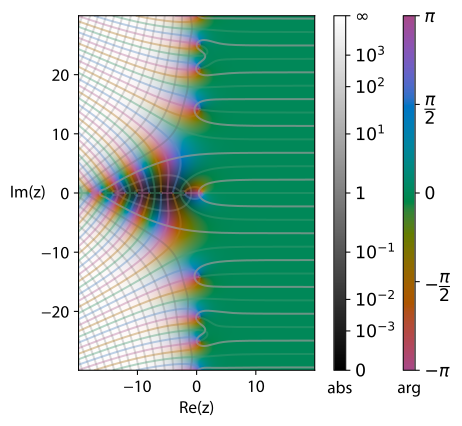
In mathematics, the Riemann zeta function, or Euler–Riemann zeta function, denoted by the lowercase Greek letter ζ {\displaystyle \zeta } (zeta), is a function of a complex variable defined as ζ ( s) = ∑ n = 1 ∞ 1 n s = 1 1 s + 1 2 s + 1 3 s + ⋯ {\displaystyle \zeta (s)=\sum _{n=1}^{\infty }{\frac {1}{n^{s}}}={\frac {1}{1^{s}}}+{\frac {1}{2^{s}}}+{\frac {1}{3^{s}}}+\cdots } for R e ( s) > 1 {\displaystyle \mathrm {Re} (s)>1} , and its analytic continuation elsewhere. The Riemann zeta function plays a pivotal role in analytic number theory and has applications in physics, probability theory, and applied statistics. Leonhard Euler first introduced and studied the function over the reals in the first half of the eighteenth century.
From Wikipedia, under CC BY-SA. More on occurri.