Product rule
Formula for the derivative of a product
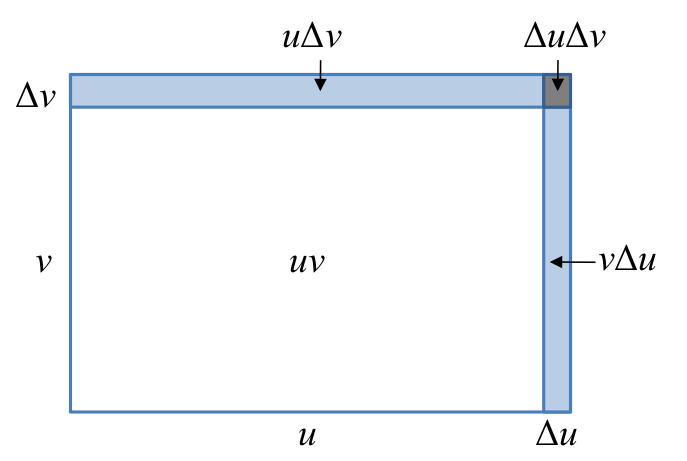
In calculus, the product rule (or Leibniz rule or Leibniz product rule) is a formula used to find the derivatives of products of two or more functions. For two functions, it may be stated in Lagrange's notation as ( u ⋅ v) ′ = u ′ ⋅ v + u ⋅ v ′ {\displaystyle (u\cdot v)'=u'\cdot v+u\cdot v'} or in Leibniz's notation as d d x ( u ⋅ v) = d u d x ⋅ v + u ⋅ d v d x . {\displaystyle {\frac {d}{dx}}(u\cdot v)={\frac {du}{dx}}\cdot v+u\cdot {\frac {dv}{dx}}.} The rule may be extended or generalized to products of three or more functions, to a rule for higher-order derivatives of a product, and to other contexts.
From Wikipedia, under CC BY-SA. More on occurri.