Law of sines
Property of all triangles on a Euclidean plane
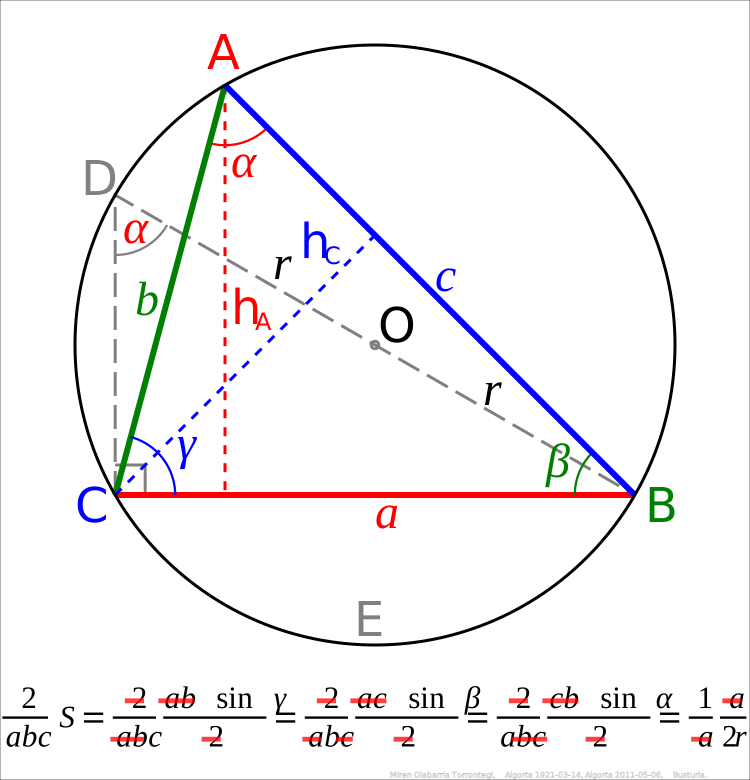
In trigonometry, the law of sines (sometimes called the sine formula or sine rule) is a mathematical equation relating the lengths of the sides of any triangle to the sines of its angles. According to the law, a sin α = b sin β = c sin γ = 2 R , {\displaystyle {\frac {a}{\sin {\alpha }}}\,=\,{\frac {b}{\sin {\beta }}}\,=\,{\frac {c}{\sin {\gamma }}}\,=\,2R,} where a, b, and c are the lengths of the sides of a triangle, and α, β, and γ are the opposite angles (see figure 2), while R is the radius of the triangle's circumcircle. When the last part of the equation is not used, the law is sometimes stated using the reciprocals; sin α a = sin β b = sin γ c .
From Wikipedia, under CC BY-SA. More on occurri.