Halide mineral
Minerals with a dominant fluoride, chloride, bromide, or iodide anion
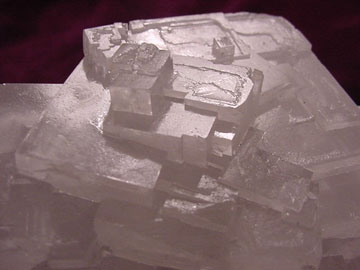
Halide minerals are those minerals with a dominant halide anion (F−, Cl−, Br− and I−). Complex halide minerals may also have polyatomic anions. Examples include the following: Atacamite Cu2Cl(OH)3 Avogadrite (K,Cs)BF Bararite (β)(NH4)2SiF6 Bischofite MgCl2·6H2O Brüggenite Ca(IO3)2(H2O) Calomel HgCl Carnallite KMgCl3·6H2O Carnallite KMgCl·6H2O Cerargyrite/Horn silver AgCl Chlorargyrite AgCl, bromargyrite AgBr, and iodargyrite AgI Cryolite Na3AlF6 Cryptohalite (a)(NH4)2SiF6 Dietzeite Ca2(IO3)2CrO4 Eglestonite Hg4OCl2 Embolite AgCl+AgBr Eriochalcite CuCl2·2H2O Fluorite CaF2 Halite NaCl Lautarite Ca(IO3)2 Marshite CuI Miersite AgI Nantokite CuCl Sal Ammoniac NH4Cl Sylvite KCl Terlinguaite Hg2OCl Tolbachite CuCl2 Villiaumite NaF Yttrocerite (Ca,Y,Ce)F2 Yttrofluorite (Ca,Y)F2 Zavaritskite (BiO)F Many of these minerals are water-soluble and are often found in arid areas in crusts and other deposits as are various borates, nitrates, iodates, bromates and the like.
From Wikipedia, under CC BY-SA. More on occurri.