Faber–Jackson relation
Power law for galaxies
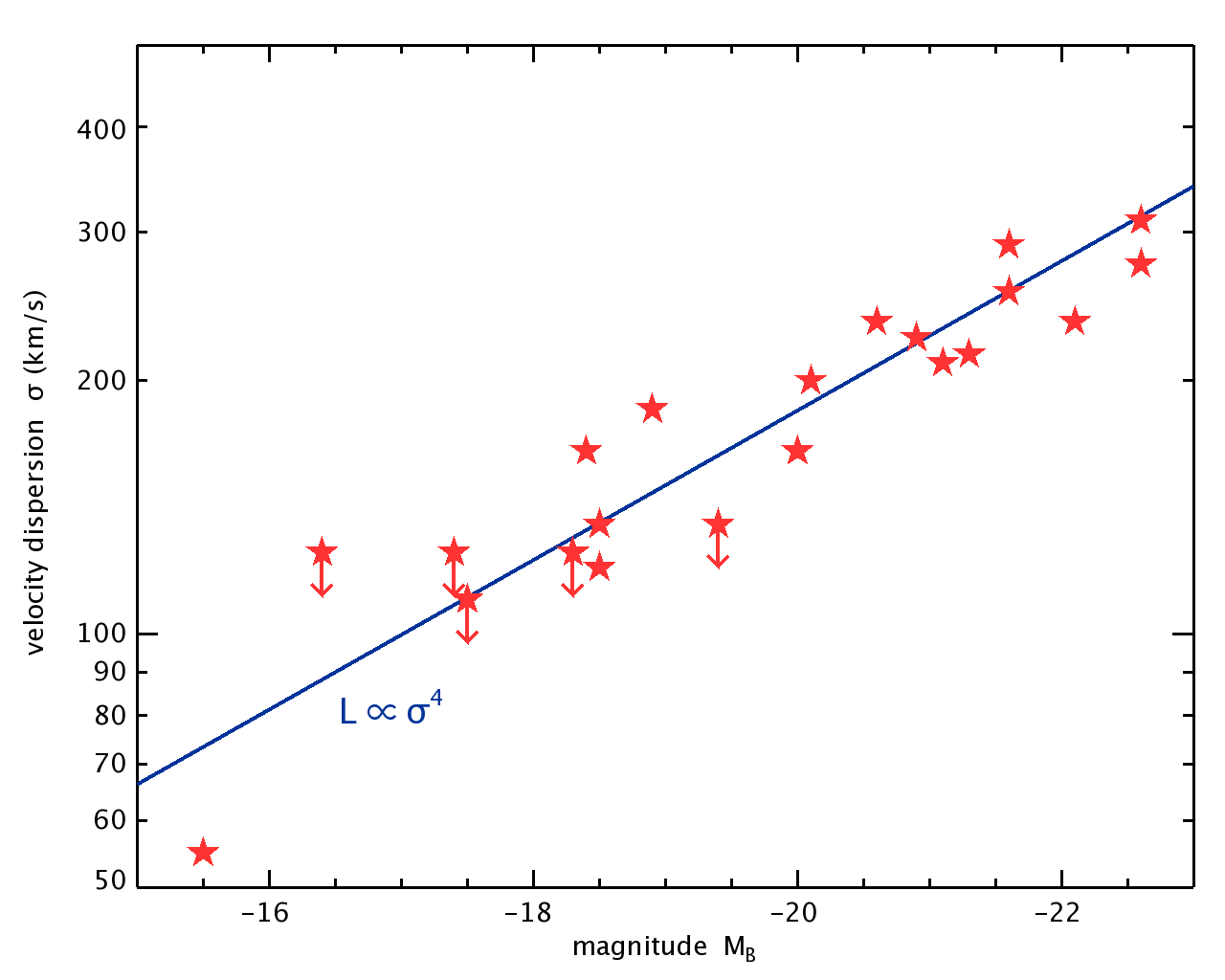
The Faber–Jackson relation provided the first empirical power-law relation between the luminosity L {\displaystyle L} and the central stellar velocity dispersion σ {\displaystyle \sigma } of elliptical galaxy, and was presented by the astronomers Sandra M. Faber and Robert Earl Jackson in 1976. Their relation can be expressed mathematically as: L ∝ σ γ {\displaystyle L\propto \sigma ^{\gamma }} with the index γ {\displaystyle \gamma } approximately equal to 4. In 1962, Rudolph Minkowski had presented a first attempt to measure a correlation between luminosity and line width, as first described for early-type galaxies in the Virgo Cluster by W.W. Morgan and N.U. Mayall, and wrote that a "correlation between velocity dispersion and [luminosity] exists, but it is poor" and that "it seems important to extend the observations to more objects, especially at low and medium absolute magnitudes".
From Wikipedia, under CC BY-SA. More on occurri.