Cumulative distribution function
Probability that random variable X is less than or equal to x
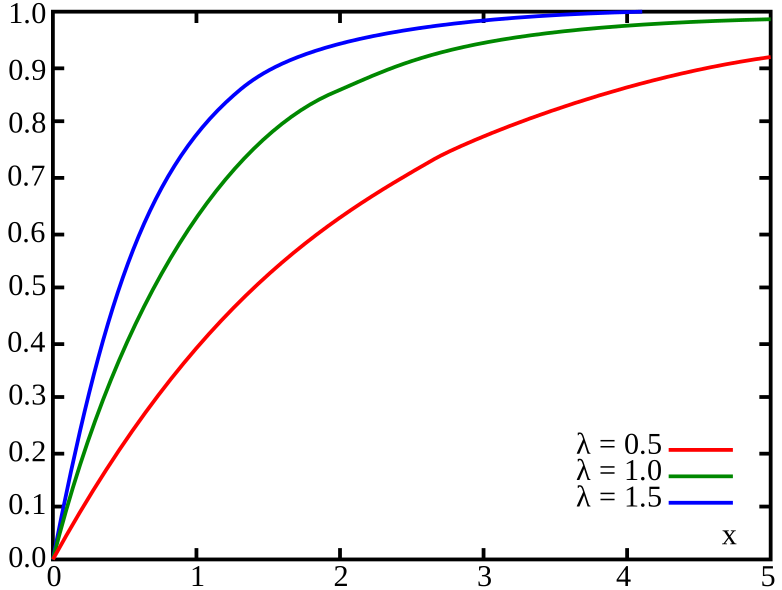
In probability theory and statistics, the cumulative distribution function (CDF) of a real-valued random variable X {\displaystyle X} , or just distribution function of X {\displaystyle X} , evaluated at x {\displaystyle x} , is the probability that X {\displaystyle X} will take a value less than or equal to x {\displaystyle x} . Every probability distribution defined on the real numbers, discrete or "mixed" as well as continuous, is uniquely identified by a right-continuous monotone increasing function (a càdlàg function) F : R → [ 0 , 1 ] {\displaystyle F\colon \mathbb {R} \rightarrow [0,1]} satisfying lim x → − ∞ F ( x) = 0 {\displaystyle \lim _{x\rightarrow -\infty }F(x)=0} and lim x → ∞ F ( x) = 1 {\displaystyle \lim _{x\rightarrow \infty }F(x)=1} . And conversely, any such function F {\displaystyle F} is the cumulative distribution function of such a probability distribution.
From Wikipedia, under CC BY-SA. More on occurri.